
From prototype to production release
New Product Introduction (NPI)
A structured NPI service supporting customers from initial prototypes through to production release, with defined planning, configuration control and cross-functional review.
New Product Introduction
Reduce programme risk before scale-up
NPI is managed through defined planning, configuration control and cross-functional review, ensuring that design intent, supply chain requirements, manufacturing processes, inspection and test expectations are aligned before scale-up.
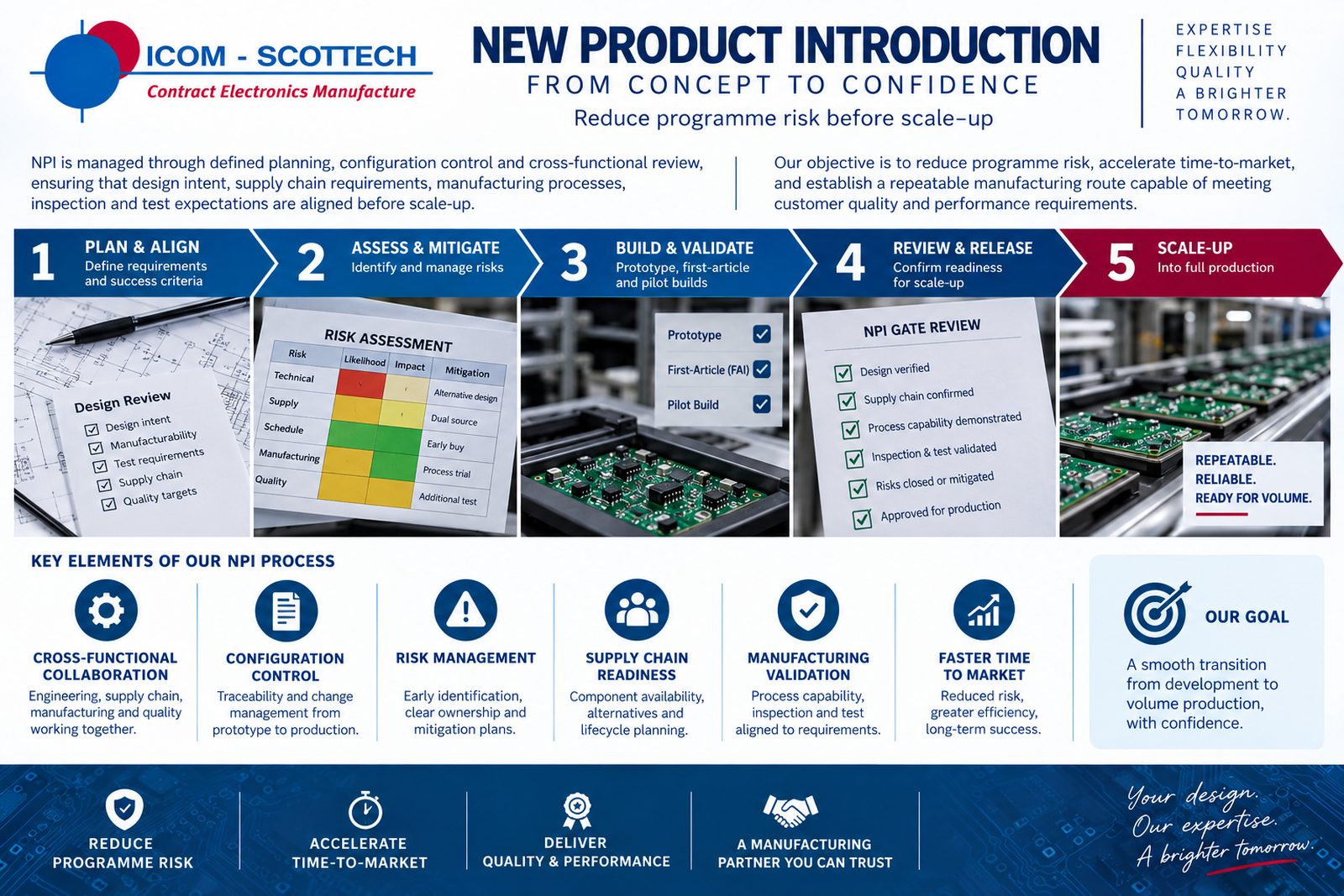
Risk management is embedded within the NPI process through early identification of technical, supply and schedule risks, clear ownership of actions, and structured reviews aligned to key build stages (for example prototype, first-article and pilot-build gates). Our objective is to reduce programme risk, accelerate time-to-market, and establish a repeatable manufacturing route capable of meeting customer quality and performance requirements.
01 / NPI stage
Fast Turnaround
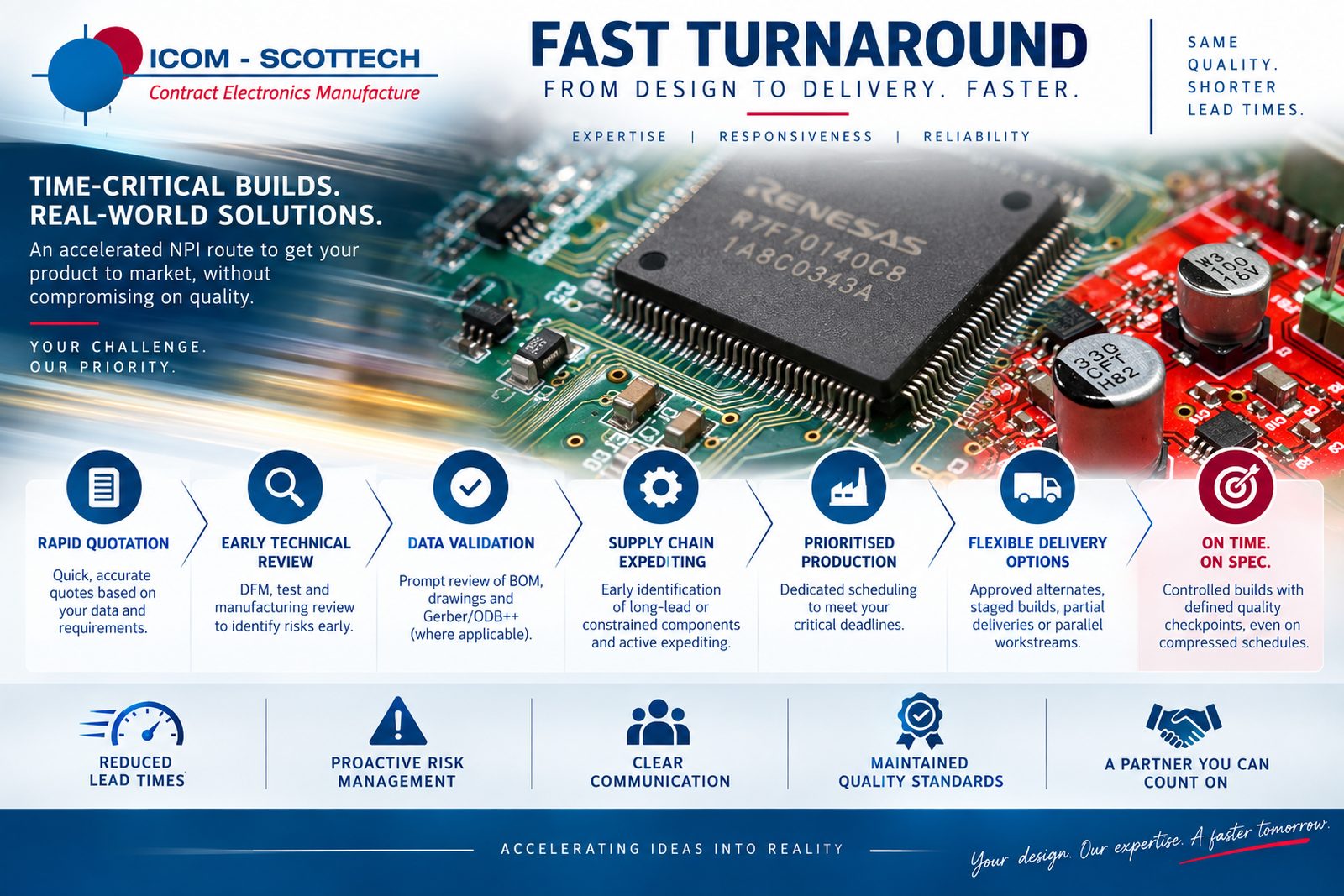
For time-critical builds, we offer an accelerated NPI route supported by rapid quotation, early technical review and prioritised production scheduling. Lead-time is reduced through prompt data validation (BOM, drawings and Gerber/ODB++ where applicable), early identification of long-lead or constrained components, and active supply-chain expediting. Programme risks associated with compressed schedules are managed through early confirmation of scope, clear communication of constraints and assumptions, and proactive escalation of issues that could impact delivery. Where necessary, we agree pragmatic mitigation actions with the customer (for example approved alternates, staged builds, partial deliveries or parallel workstreams) to protect milestones whilst maintaining controlled documentation and defined quality checkpoints.
02 / NPI stage
Small Batch / Prototypes
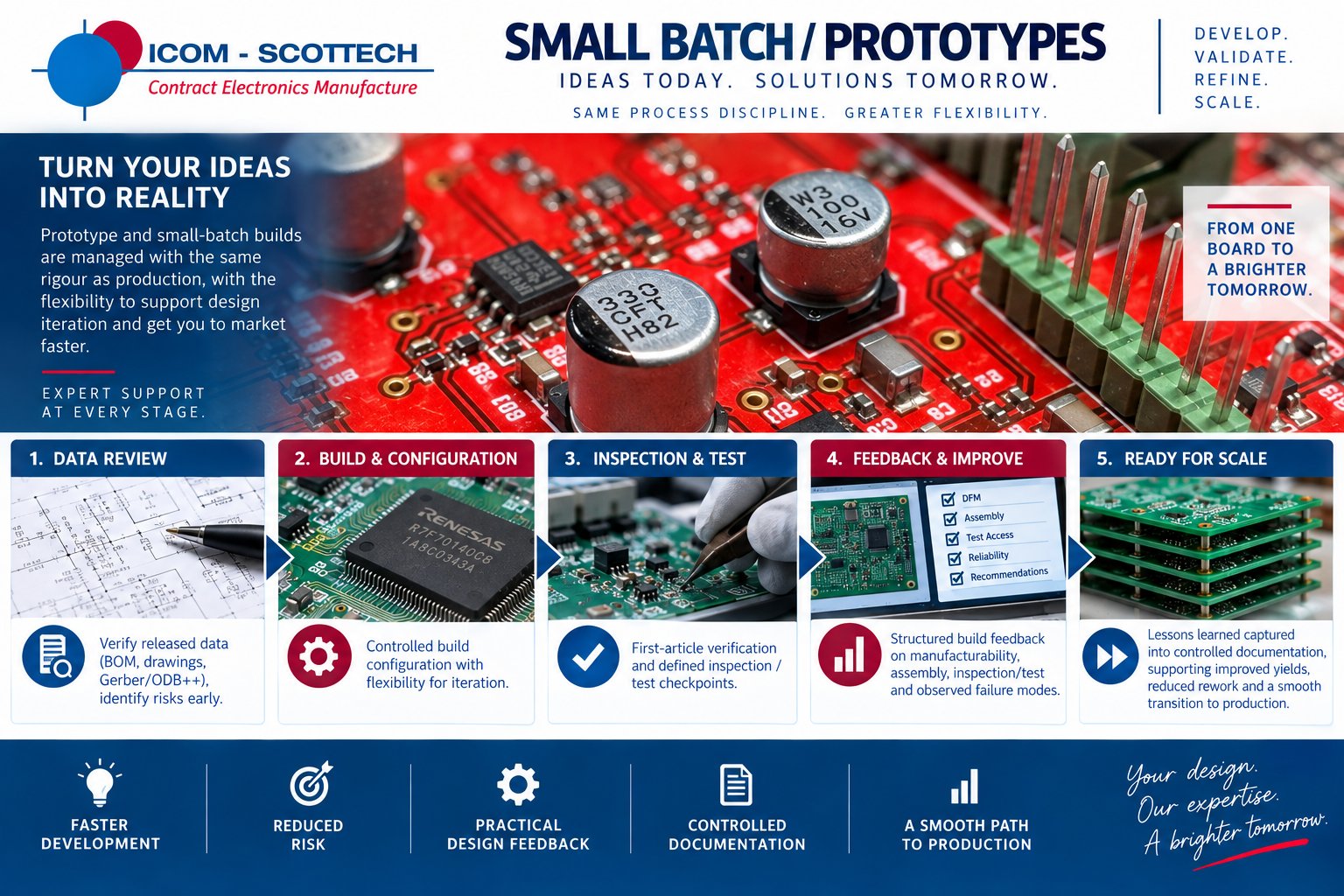
Prototype and small-batch builds are managed using the same process discipline applied to production, with added flexibility to support design iteration. Risk is reduced by verifying the released data set early, controlling the build configuration, and using first-article verification and defined inspection/test checkpoints to contain issues at the earliest stage. We provide structured build feedback on manufacturability, assembly sequence, inspection/test access and observed failure modes, enabling rapid corrective action and design refinement. Lessons learned are captured into controlled work instructions, build packs and test processes, supporting improved yields, reduced rework and a smoother transition from pre-production to repeat manufacture.
03 / NPI stage
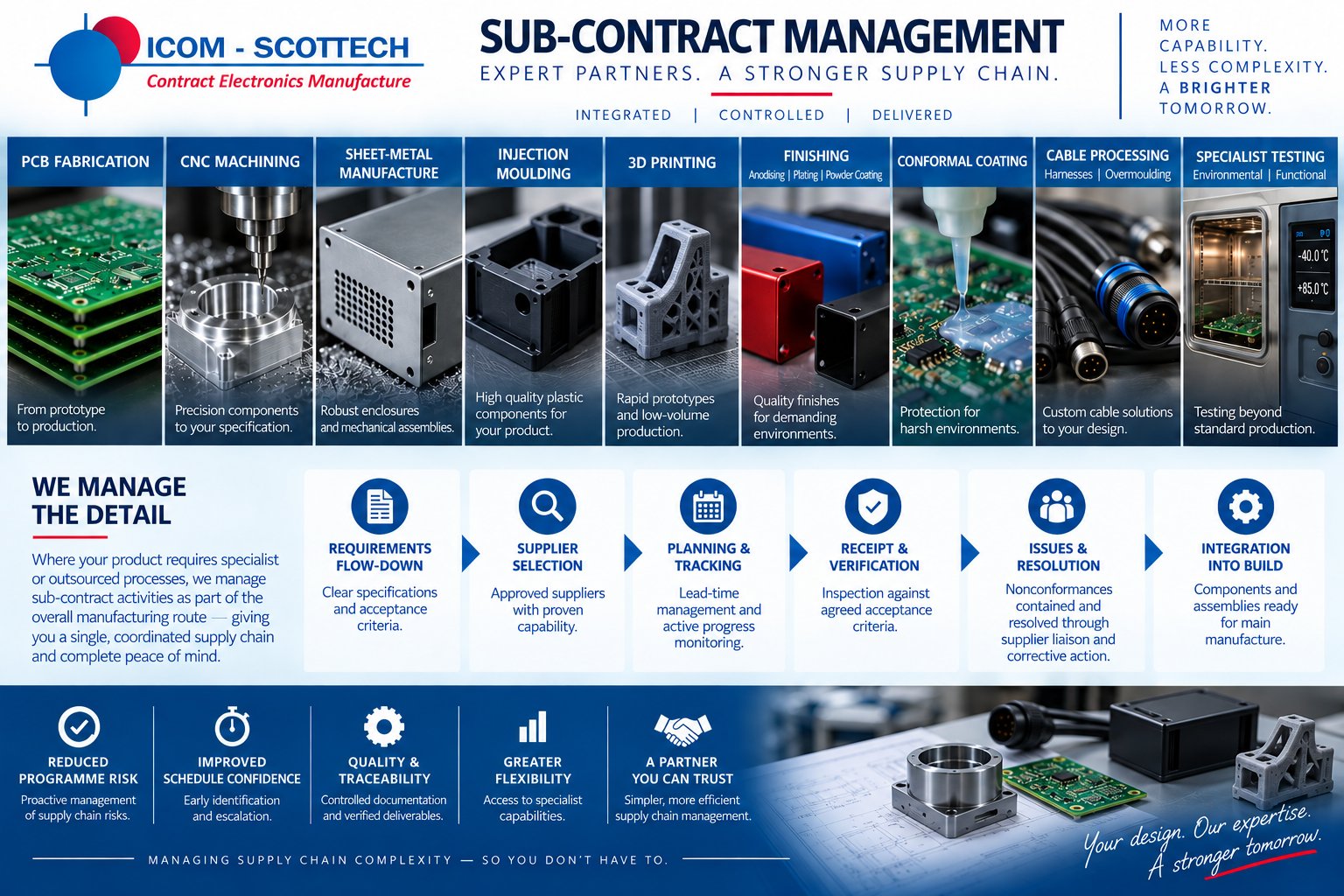
Sub-Contract Management
Where NPI requires specialist or outsourced processes, we can manage sub-contract activities as part of the overall manufacturing route. This may include control of external services such as bare PCB fabrication, CNC machining and sheet-metal manufacture, finishing processes (for example anodising, plating or powder coating), conformal coating and associated masking, specialist cable processing (including overmoulding where specified), custom test fixture manufacture, and specialist test activities such as environmental screening. Sub-contract risk is managed through clear requirement flow-down, confirmation of supplier capability and lead-time, active progress tracking and early escalation of delays or technical queries. Deliverables are verified on receipt against agreed acceptance criteria, with nonconformances contained and resolved through controlled supplier liaison and corrective action. This coordinated approach reduces programme complexity for the customer and helps to maintain schedule, traceability and configuration integrity across the full supply chain.
04 / NPI stage
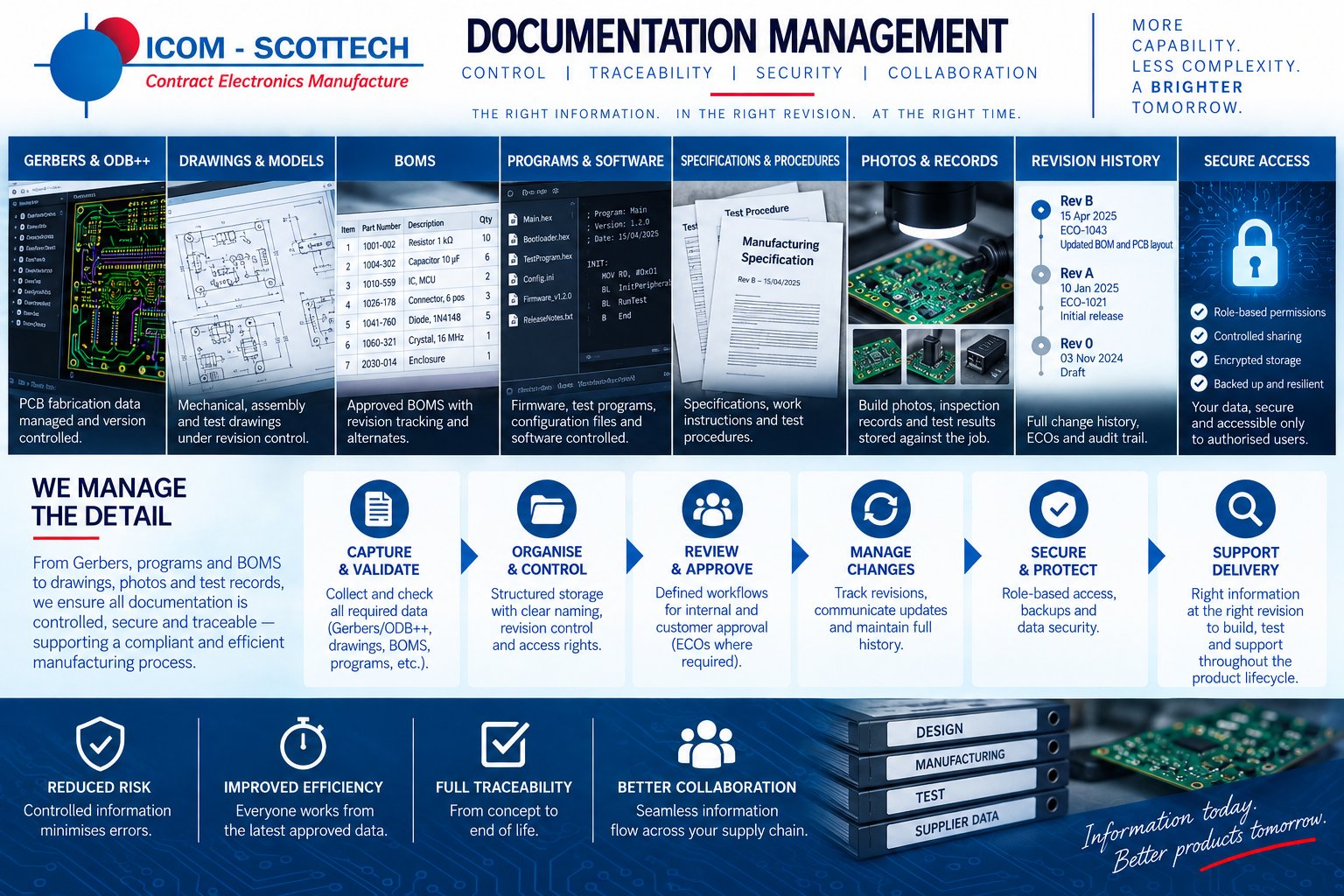
Documentation Management
NPI is supported by disciplined documentation management to ensure that manufacturing is always performed to the correct and current requirements. We work with customers to confirm the released data set (BOM/AVL, drawings, fabrication notes, assembly instructions and test specifications) and to establish clear revision baselines for procurement, build and programming. Documentation-related risk (for example wrong-revision build, uncontrolled substitution or ambiguous requirements) is managed through change-control routes with impact assessment, controlled distribution of build packs and clear identification of applicable versions. Engineering changes are implemented in a controlled manner and reflected in work instructions and traceability records, supporting repeatability and auditability through to repeat production.
05 / NPI stage
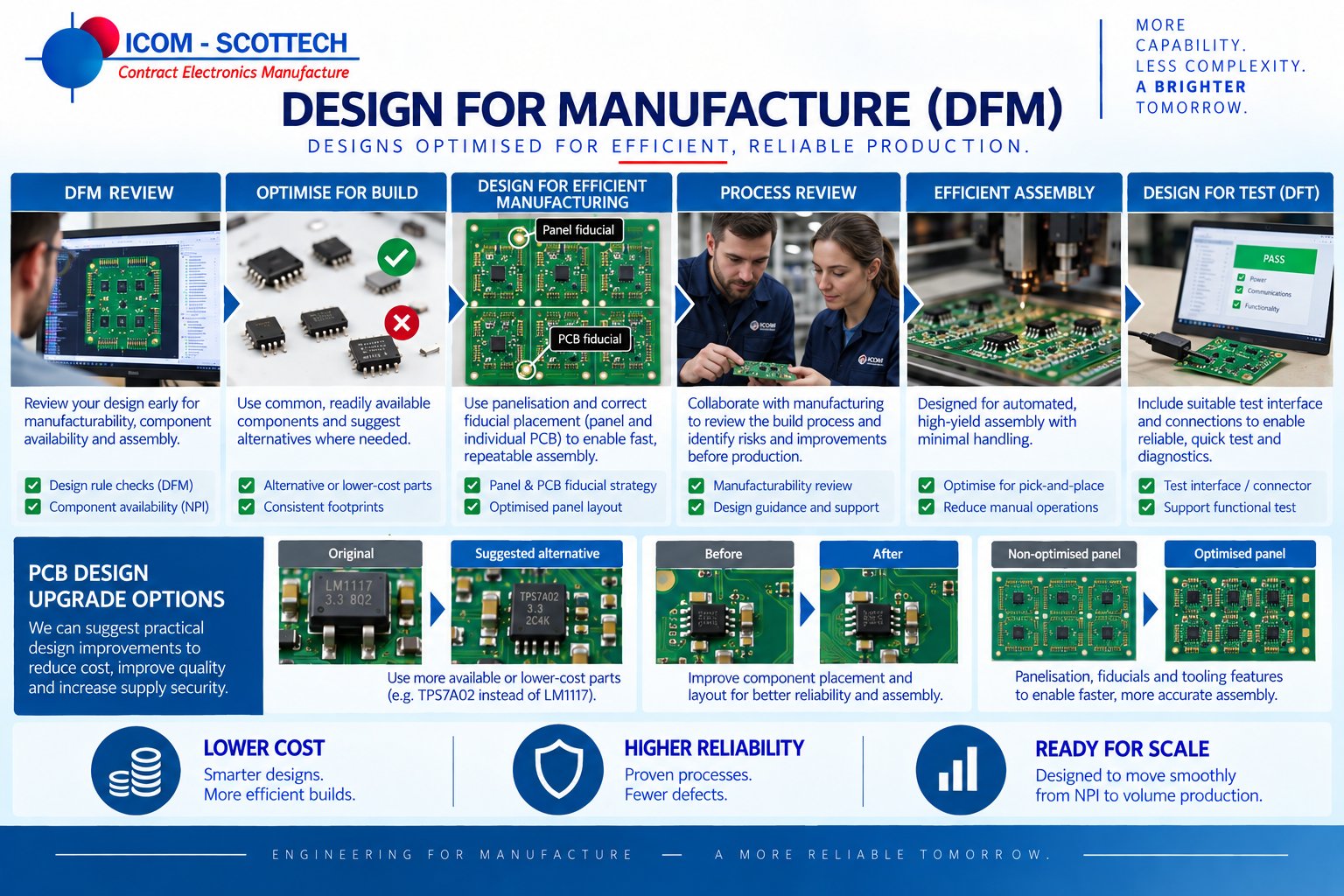
Design for Manufacture
DFM is integral to NPI and is applied as a primary risk-reduction activity prior to production scale-up. We review buildability across electronics, cable harness and mechanical integration, including component availability, footprint/orientation conventions, access for tooling, and design-for-test (DFT) provisions such as test-point strategy and connector selection. Workmanship and acceptance criteria (including the applicable IPC class where specified) are agreed and translated into controlled processes, inspection checkpoints and test limits. Where appropriate, first-article and pilot builds are used to validate the manufacturing route, confirm yields and establish stable process parameters, with actions tracked to closure before formal production release.
Discuss your NPI requirements
Talk to us about your new product and we will help you plan a controlled route to production release.